Voted #1 Family Law Firm in California
in a statewide poll limited to Judges, Attorneys, and Law Firm Administrators.
Request a Consultation



California holds these agreements to a demanding standard. To be enforceable, both parties must fully disclose their finances, retain independent legal counsel, and sign voluntarily after a mandatory seven-day review period. Courts will void agreements, or specific provisions within them, that fall short of these requirements. Schoenberg Family Law Group, P.C. represents clients throughout Orange County in all matters of family law, including prenuptial agreements. Whether you’re a business owner in Irvine, a physician or biotech professional with equity compensation, or someone entering a second marriage with assets to protect, our legal team crafts agreements that are thorough, enforceable, and built around your actual circumstances.
California is a community property state. Without a premarital agreement, assets acquired during the marriage are presumed equally owned by both spouses upon divorce. A properly drafted prenuptial agreement lets couples step outside those default rules and build a financial framework that matches their actual intentions. Working with an experienced Orange County prenuptial agreement lawyer, you can address:
Addressing these issues before the wedding removes ambiguity and sets the stage for honest financial communication throughout the marriage. Our team pays meticulous attention to the characterization and documentation of assets so your agreement holds up if it’s ever challenged.
California law draws firm boundaries around what a premarital contract can address. Matters involving children or personal lifestyle fall outside the scope of any prenuptial agreement, including:
Attempting to include restricted terms doesn’t just make those individual clauses unenforceable; it can give a court grounds to throw out the agreement altogether. We draft with precision specifically to avoid these pitfalls.
Most couples underestimate how much time a properly executed prenuptial agreement takes. Here’s what the process typically looks like:
Starting this process at least three to four months before the wedding gives both sides adequate time at every stage without added pressure.
A prenuptial agreement is only as strong as its drafting. California follows the Uniform Premarital Agreement Act (UPAA), and courts closely scrutinize these documents when challenged. For an agreement to be enforceable, it must meet four core requirements:
Missing even one of these requirements can render the entire agreement void in Orange County Superior Court. Our team manages every step of the process to ensure full compliance.
Prenuptial agreements demand more than filling in a template. They require a thorough understanding of California property law, careful financial analysis, and precise drafting that holds up under courtroom scrutiny years down the road. Schoenberg Family Law Group has served families for nearly four decades. Our longevity reflects not just experience, but a consistent track record of protecting clients’ financial futures with precision and integrity.
This institutional knowledge is guided by our founder, Debra Schoenberg, a Certified Family Law Specialist whose expertise spans complex family wealth structures, premarital protections, and high-asset business dynamics. Because our firm understands exactly how prenuptial agreements are scrutinized during a dissolution, we draft marital contracts rigorously and defensively, ensuring every document is grounded in transparency and legal compliance.
When you work with our team, you can expect:
We approach every prenuptial matter with the same care and discretion our clients bring to the rest of their financial lives.
Schoenberg Family Law Group, P.C. has the knowledge and precision to make sure your prenuptial agreement is thorough, accurate, and built to last. We take financial disclosures seriously, draft with enforceability in mind, and guide clients through the process in a way that supports, rather than strains, the relationship you’re building. If you’re considering a prenuptial agreement anywhere in Orange County, contact our office at 866.618.2132 or fill out our online form. We’re ready to help you protect your future.
"I was seeking a reputable family law firm for my prenuptial agreement and received high praise for the Schoenberg Law Group. My attorney listened to my questions and responded to them very patiently. She also paid close attention all my concerns and made sure I was aware of the legal value of the agreement I was about to sign. It was…”
D.R.“It has been a real blessing to find this family law group in my life. I was in the middle of a custody battle with my ex wife and had a lawyer who had sided with my ex wife’s lawyer. I was faced with the option of paying to a regular lawyer to do half jobs with no results or to invest a bit more for a top family counselor who understood my situation and at the same time not giving me false hopes."
A.L."I hesitated filing papers for a long time because I was not sure if I could survive a long legal battle. When we were married, my husband worked while I raised the children, two under four years old, and I was afraid I would lose the stability they needed. I had a wonderful group of friends that helped me search for a reputable law firm that could represent me when my focus was on my children. They found the"
L.A.We are trial lawyers who litigate high-conflict, high-stakes cases. While we try to build on mediation efforts and exhaust opportunities for a negotiated agreement, emotions, egos and various other realities often force these disputes into court. It is critical to work with a firm that knows how to apply the law and the facts in your favor, whether in the courtroom or at the negotiating table.
One of California’s Top Family Lawyers for five consecutive years: 2022–2026

SFLG Voted #1 Family Law Firm in California for six consecutive years: 2021 - 2026

One of the Best Places to Work in the Bay Area by San Francisco Business Times

Debra Schoenberg was named a Fellow of the American Academy of Matrimonial Lawyers (AAML)
Designated as a Certified Family Law Specialist by the State of California Board of Legal Specialization
Board-Certified Family Law Trial Specialist by The National Board of Trial Advocacy (NBTA)
“My goal is to preserve your dignity and your humanity throughout what can be a very difficult and painful process, while at the same time achieving a favorable outcome on your behalf.”
Over 400 Years of Collective Family Law Experience
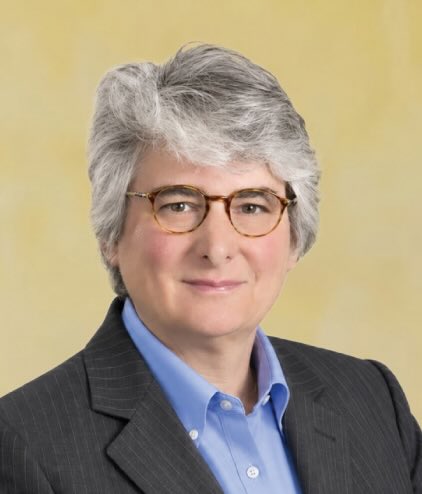 Debra R. Schoenberg
Owner & Founder
Debra R. Schoenberg
Owner & Founder


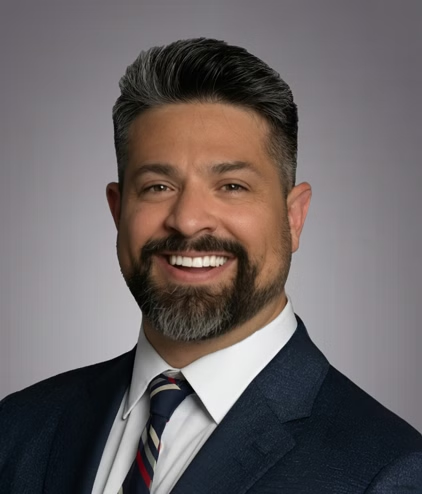





 Lily Huang
Senior Associate
Lily Huang
Senior Associate
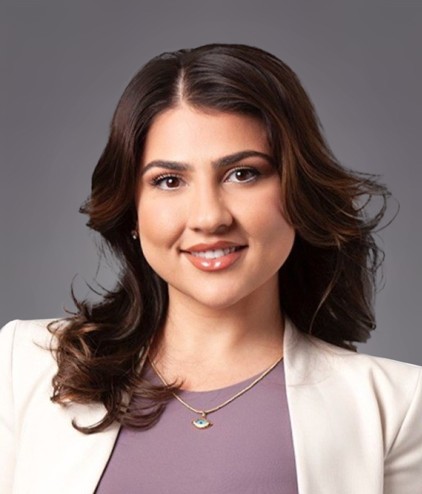 Kimia Kojouri
Associate
Kimia Kojouri
Associate




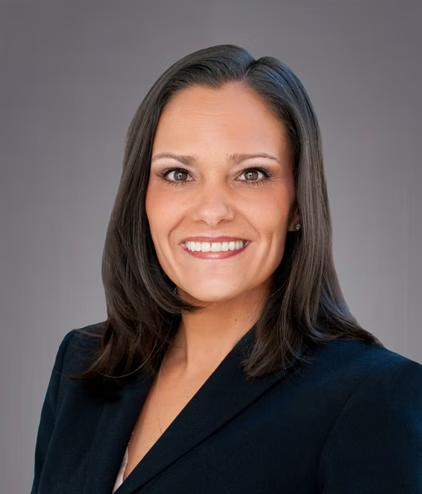
 Miho Takarada
Senior Counsel
Miho Takarada
Senior Counsel
California's community property laws apply to everyone, not just high-net-worth individuals. If you own a home, have a retirement account, run a business, or have children from a prior relationship, a prenuptial agreement gives you control over how your assets are treated if the marriage ends. Without one, the court decides.
Yes. Agreements signed under duress, without adequate financial disclosure, or without sufficient time to review with independent counsel are vulnerable to challenge. Professional drafting significantly reduces that risk.
No, and most clients find the opposite to be true. Working through an honest discussion of finances, debts, goals, and expectations before the wedding tends to strengthen a relationship rather than strain it.
Yes, with conditions. The party waiving support must have had independent legal counsel, and a court won't enforce a waiver it finds unconscionable at the time of divorce, particularly if circumstances have changed dramatically.
A prenuptial agreement is signed before the wedding. A postnuptial agreement is executed after the couple is already married. Both serve similar protective functions, but courts review them against somewhat different standards.
Yes. Designating your business as separate property and documenting its value at the time of marriage can prevent its growth and income from being treated as a community asset in the event of divorce.
Yes. Independent legal representation for both parties is strongly recommended and often legally required. It protects the validity of the agreement and ensures neither party can later claim they didn't understand what they signed.
It can. If you're entering the marriage with student loans, a business line of credit, or other liabilities, the agreement can specify that those debts remain your sole responsibility and can't be claimed against your spouse's assets.
At least three to four months before the wedding. California's seven-day review rule is a minimum, not a recommended timeline. Gathering financial disclosures, negotiating terms, and allowing both attorneys adequate review time all take longer than most couples expect.
California's community property default rules take over. Assets and debts acquired during the marriage are divided equally at divorce, regardless of who earned the income, whose name is on the account, or what either party intended.