Voted #1 Family Law Firm in California
in a statewide poll limited to Judges, Attorneys, and Law Firm Administrators.
Request a Consultation
Divorce is never easy. Even agreed divorces can escalate into complicated and contentious disputes, especially when assets and children are involved. The decisions you make during your divorce have the potential to affect your life and the lives of your children for years to come. The Santa Rosa family law attorneys at the Schoenberg Family Law Group, P.C., understand families and family law disputes. Our goal is to offer you honest, practical solutions to your divorce problems. When possible, our skilled Santa Rosa divorce attorney resolves heated matters outside of the courtroom rather than in litigation.
Contact the Schoenberg Family Law Group, P.C. to discuss your divorce with attorneys who are:
We can answer your most pressing divorce questions and help to set your mind at ease.
An experienced divorce attorney is an invaluable asset that can save you time, money, and frustration. There is no reason to attempt tackling your divorce alone when you can have a team of professionals on your side. At the Schoenberg Family Law Group, P.C., we strive to protect your legal interests both during your divorce and well into the future.
It is crucial to the divorce attorneys that we:
Speak with a divorce professional at the Schoenberg Family Law Group, P.C. today about your case. Your consultation will be scheduled at your convenience and kept completely confidential.
 Helpful and supportive
Debra and team were so helpful and supportive through the most difficult time in my life. Grateful to the team for their advice – would highly recommend their services to anyone needing a divorce attorney.
Santa Rosa, California has specific residency requirements for divorce. In California, one spouse must be a resident of the state for at least six months before filing for a divorce. That same spouse must reside in the county where they plan to file for a divorce a minimum of three months before the divorce.

California has a mandatory six-month waiting period between filing for a divorce and the date a divorce is granted by the court. There are no exceptions to this rule, not even for an agreed divorce.
California is a community property state. This means that without the benefit of a prenuptial or postnuptial agreement defining property rights and responsibilities in the event of a divorce, the court will divide the marital property and debts equally.
Separate property is not considered community property and, therefore, is not included in the division of marital property in a divorce.
A spouse’s separate property includes:
California allows for temporary, rehabilitative, permanent, and reimbursement spousal support. However, before spousal support can be awarded, one spouse must have financial needs, and the other must have the ability to pay.
The court reviews the following factors when it considers ordering spousal support:
Spousal support stops when any of the following occurs:
In California, custody decisions are based on the best interests of the child. The best interests of the child include, but are not limited to:
The following may also influence a custody decision:
The court has no gender bias in regards to a custody award.
There is a set of statewide guidelines, including a mathematical formula, in California for calculating child support. Parents or the court can set a child support obligation. If parents create their own agreement, it still needs to meet California’s guideline requirements.
The guideline calculation takes the following and more into account:
Travel expenses, educational expenses, and special needs may also be included in child support calculations.
If you would like to discuss filing for divorce in Santa Rosa with an experienced Santa Rosa divorce attorney, call the Schoenberg Family Law Group, P.C. We have over thirty-five years of experience and focus solely on the practice of family law.
Do not trust your divorce to a multi-practice firm. At the Schoenberg Family Law Group, P.C., you will work with skilled and dedicated family law attorneys who know California divorce laws and how to best meet your divorce needs and goals.
Let the Schoenberg Family Law Group, P.C. answer your questions about any of the above divorce issues and more by reaching out to our Santa Rosa office today. Contact us online today.
"I was seeking a reputable family law firm for my prenuptial agreement and received high praise for the Schoenberg Law Group. My attorney listened to my questions and responded to them very patiently. She also paid close attention all my concerns and made sure I was aware of the legal value of the agreement I was about to sign. It was…”
D.R.“It has been a real blessing to find this family law group in my life. I was in the middle of a custody battle with my ex wife and had a lawyer who had sided with my ex wife’s lawyer. I was faced with the option of paying to a regular lawyer to do half jobs with no results or to invest a bit more for a top family counselor who understood my situation and at the same time not giving me false hopes."
A.L."I hesitated filing papers for a long time because I was not sure if I could survive a long legal battle. When we were married, my husband worked while I raised the children, two under four years old, and I was afraid I would lose the stability they needed. I had a wonderful group of friends that helped me search for a reputable law firm that could represent me when my focus was on my children. They found the"
L.A.We are trial lawyers who litigate high-conflict, high-stakes cases. While we try to build on mediation efforts and exhaust opportunities for a negotiated agreement, emotions, egos and various other realities often force these disputes into court. It is critical to work with a firm that knows how to apply the law and the facts in your favor, whether in the courtroom or at the negotiating table.
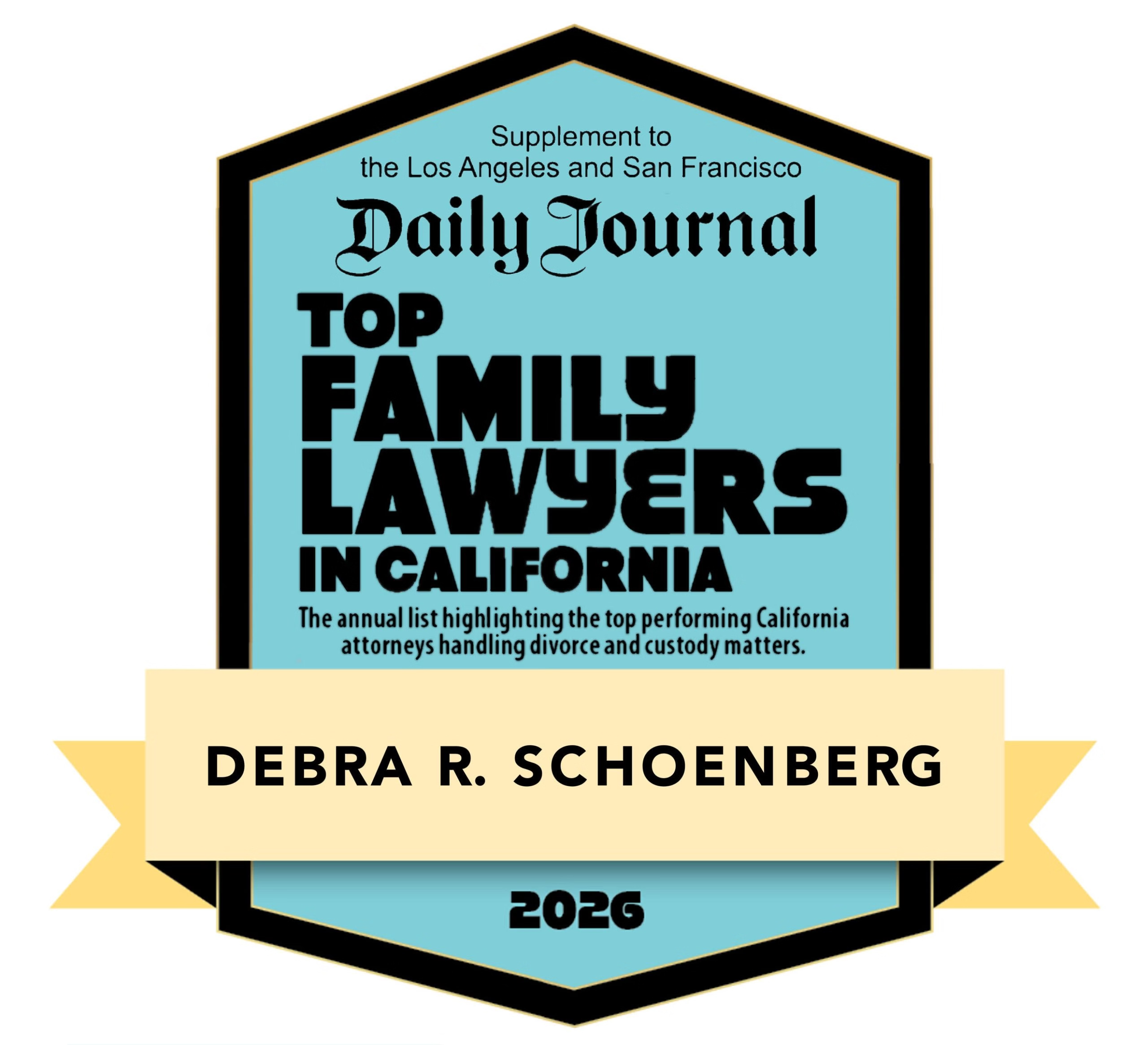
One of California’s Top Family Lawyers for five consecutive years: 2022–2026

SFLG Voted #1 Family Law Firm in California for six consecutive years: 2021 - 2026

One of the Best Places to Work in the Bay Area by San Francisco Business Times

Debra Schoenberg was named a Fellow of the American Academy of Matrimonial Lawyers (AAML)
Designated as a Certified Family Law Specialist by the State of California Board of Legal Specialization

Board-Certified Family Law Trial Specialist by The National Board of Trial Advocacy (NBTA)
“My goal is to preserve your dignity and your humanity throughout what can be a very difficult and painful process, while at the same time achieving a favorable outcome on your behalf.”
Over 400 Years of Collective Family Law Experience
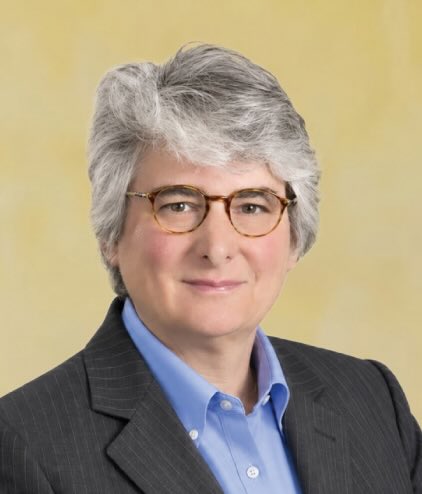 Debra R. Schoenberg
Owner & Founder
Debra R. Schoenberg
Owner & Founder









 Lily Huang
Senior Associate
Lily Huang
Senior Associate
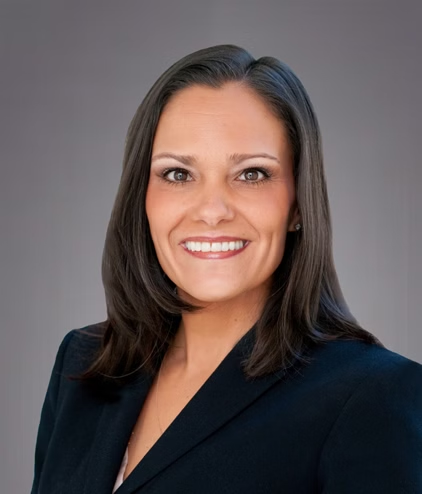
 Kimia Kojouri
Associate
Kimia Kojouri
Associate




Divorce cases for Santa Rosa residents are filed with the Sonoma County Superior Court. After the Petition is filed and served, the case proceeds through financial disclosures, negotiations, and, if necessary, court hearings before a final judgment is entered.
Many divorces are resolved through negotiation or mediation without requiring a trial. If spouses reach agreements on all major issues, the court can often approve those agreements without extensive courtroom proceedings.
Every divorce is different, but contested cases involving custody, property division, or support generally take longer than uncontested divorces. While California requires a minimum six-month waiting period, more complex cases can take a year or longer to resolve.
The family home may be classified as community or separate property depending on when and how it was acquired. Whether the home is sold, retained by one spouse, or divided in another manner depends on the facts of the case and any agreement reached between the parties.
Mediation is commonly used to help spouses resolve disputes before trial, and parents involved in contested custody matters are required to participate in Family Court Services mediation before a judge will make custody decisions. Successfully resolving issues through mediation can reduce both the time and expense involved in a divorce.
Yes. Divorce proceedings commonly address child custody, parenting time, child support, property division, and spousal support in the same case. Resolving these issues together helps establish a comprehensive final judgment.